
Main -> Enigma
|
Main -> Enigma |
| Simulators | Information | Links |
During the Second World War, German military and diplomatic communications were encoded using an electro-mechanical tool codenamed "Enigma".
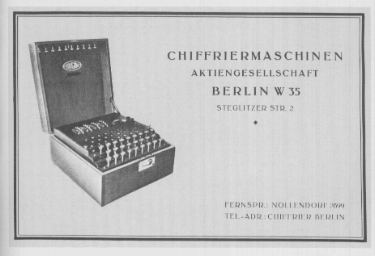
This device consisted of three wheels (chosen from a standard set) which were individually wired to change one letter code to another. To further encrypt the message, after each character, the wheels would be incremented (like a car's odometer) so that a different letter code would be produced for repeated characters. As I understand the it, Enigma could only encrypt the twenty-six letters of the alphabet (which means all messages had to be in characters with no numbers, blanks or punctuation).
A message was encoded using an agreed to (between the transmitter and receiver) set of wheels with specific starting positions. To encrypt the message, the text was simply keyed into the Enigma's keyboard and a light representing the encoded character was lit. Decoding messages was simply done by reversing the order of the wheels and running through the process again.
England's ability to decode messages encrypted on "Enigma" machines was characterized as the greatest secret of the Second World War. It was so secret that this capability was unknown outside government circles until the war had been over for thirty years!
The reason why "Ultra" (which was the British code name for the decoding effort) was kept secret for so long seems to be motivated by protecting the governments of the time and avoid the embarrassment of having to explain why they allowed the Germans to bomb cities without taking measures to protect civilians. The bombing of Coventry in 1940 was known to Prime Minister Churchill beforehand, who deliberately did not order the evacuation of civilians or the bolstering of anti-aircraft defenses before the raid in fear of tipping off the Germans that they were able to decode their most secret communications.
The decoding of the "Enigma" messages by the English was accomplished by knowing parts of messages (such as the transmitting station's call letters) and trying every possible wheel and initial position to find those parts of the message that matched. This was done on a variety of elctro-mechanical computing "engines" which were design to run through different combinations as quickly as possible to find the known clear-text parts of the messages.
Along with this decoding effort was the American's "Magic" program which was used to decode Japanese diplomatic codes (which were used for military communications). The Americans took a different tack from the English and developed decrypting engines based on standard phone switching equipment (the English engines used custom hardware). The American's "engines" were much cheaper, faster and more reliable than their counterparts across the channel.
Since putting up the Microsoft Windows version of the Enigma Simulator, I have received a fair amount of email complaining about this page and how this write up is prejudiced against the codebreakers that operated in Poland before the German invasion as well as during the occupation. In no way is this page meant to slight the efforts of the Poles in breaking the German codes during the war.
I will make one comment and a request for information on this subject. The emails I have received have all been of the nature of: "Why don't you write more about the Polish scientists as they completely broke the German codes even before the British started to try?" The italics are mine.
There are a few web sites that describe these efforts in very basic terms and none of them seem to grasp the complexity of the work done by the British and Americans and why it is unreasonable to think that anyone was able to break the all the codes simply because there was so many and the work required to even break one code was monumental.
To give you an idea of the work required, you must realize that, on average, it took six months of effort (with early computers) to "break" one wheel selection and settings. Over the course of the war, the Germans specified several thousand different wheel selections and settings.
In this time period (from 1938 to 1945), the British decoded approximately 50,000 messages. While this sounds like an awful lot, you must consider that over these seven years, an average of two thousand messages were intercepted each day. Doing the math, this means that more than five million messages were received. Of this total, less than one percent were ever read by the British.
This is why I am skeptical about claims made that Polish partisans were ever able to "completely" decode the German messages. I am sure that a fraction of the German message traffic was intercepted and decoded, but I doubt that anything more than a handful of the messages were ever decoded.
Now having said this, I am still interested in what was done by the Poles during World War II. If you know of any references to the work that was done, have any pointers into the Polish government where I could learn more or know of anyone who was involved in the effort, I would appreciate it if you would contact me with the information. I feel like the efforts of the Polish codebreakers have been largely ignored by history and I think that this omission should be rectified.